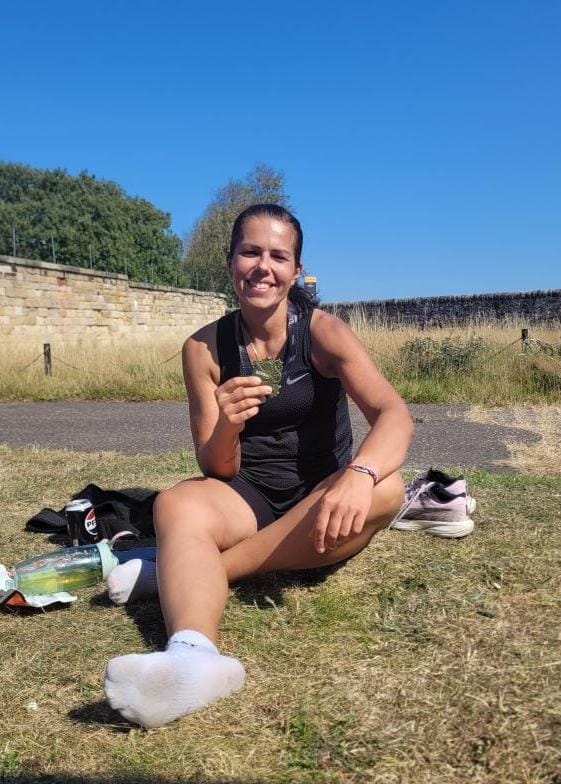
Some of the most interesting questions I've asked haven't come from textbooks. They've come from conversations on the gym floor and my personal experience, especially during my running journey.
Recently, one question has stayed with me.
How can someone objectively improve... and still leave feeling like it wasn't enough?
Imagine you've been training for your first 5K. A few months ago, simply finishing the distance felt impossible...
Yesterday, you ran it in 28 minutes. Your Personal Best!
You finished smiling. Perhaps first time feeling so proud of your run!
Later that evening, you opened social media.
Someone had just posted a 16-minute 5K.
Your watch still says 28:00. But somehow your PB just feels different...
So what changed?
That question sent me back to one of the most influential papers in psychology.
While reading Leon Festinger's original paper, A Theory of Social Comparison Processes (1954), one paragraph completely changed the way I think about coaching. Festinger argued that people have a natural drive to evaluate their own abilities. But he also recognised something important:
Not everything can be evaluated in the same way.
He distinguished between opinions and abilities because they rely on different sources of information. Opinions often have no objective standard against which they can be judged.
For example: “Am I a good poet?”
There is no stopwatch. No universally accepted score. No single correct answer.
As a result, we naturally rely more on feedback from other people when evaluating ourselves.
Some abilities, however, can be evaluated against an objective criterion.
Running is a good example.
If your 5K time improves from 30 minutes to 28 minutes, your performance has objectively improved.
The stopwatch provides evidence that doesn't depend on anyone else's opinion. In theory, evaluating your progress should therefore be straightforward.
And yet...
Many of us still look beyond the stopwatch.
Instead of asking: “Did I improve?” we ask: “How does my improvement compare with somebody else's?”
That, to me, is where psychology becomes fascinating.
Having an objective measure doesn't necessarily mean we use it as our primary source of self-evaluation. Instead, we often replace objective evidence with social comparison. Some aspects of performance can be measured objectively.
The meaning we attach to those measurements is psychological.
The personal best didn't disappear. The interpretation changed.
More than seventy years later, researchers are still exploring what happens when we compare ourselves with others.
One recent intervention study found that people encouraged to compare themselves with higher performers often reported greater motivation. But they also experienced more negative emotions and, perhaps most surprisingly, made less progress towards their own goals by the end of the study than participants encouraged to make downward comparisons.
That finding stayed with me.
It reminded me that feeling motivated isn't always the same as moving forward.
More recent research suggests something equally important. The impact of comparison doesn't simply depend on whether we compare ourselves upward or downward. It also depends on whom we compare ourselves with.
Someone just ahead of us may inspire learning. However, someone who feels impossibly far ahead may leave us questioning ourselves instead.
As I reflected on these studies, I realised they echoed something I've observed repeatedly in coaching.
We spend a lot of time measuring performance: times, weights, distance, heart rate... And yes, those numbers tell us what happened. But they don't tell us what the experience meant.
A stopwatch can measure performance — yet it cannot measure confidence. Or disappointment. Or self-belief.
That's where coaching begins.
Reading this research hasn't convinced me that we should stop comparing ourselves. If anything, it's convinced me that comparison is part of learning. The more interesting question might be:
What am I using this comparison for? To learn? Or to decide whether I'm enough? And those are two very different psychological processes.
Train & Thrive reflection
Before your next workout, pause for a moment and ask yourself:
- What are the objective facts?
- What story is my mind adding to those facts?
- Compare with who I was three months ago; how have I grown?
- Is this comparison helping me learn, or making me question my worth?
Your watch measures your performance.
Your mind interprets that performance and gives it meaning.
Understanding both may be one of the most overlooked parts of improving performance, and one of the reasons I believe psychology has an important place alongside coaching, not outside of it.
For this week (and more to come), I encourage you to try something different:
The next time you finish a workout or achieve a personal best, don't look at anyone else's results straight away. Spend one minute with your own performance before someone else's becomes your reference point.
Ask yourself: What do these numbers mean to me before I let someone else's numbers change their meaning?
Perhaps that's part of what I call the Invisible Workout.
Further reading
- Festinger, L. (1954). A Theory of Social Comparison Processes.
- Diel, K., et al. (2025). Prepare to Compare: Effects of an Intervention Involving Upward and Downward Social Comparisons on Goal Pursuit in Daily Life.
- Le Blanc-Brillon, A., et al. (2025). Research on social comparison, self-esteem and social media.
Originally published on LinkedIn.