That single experiment, run by neuroscientist Kent Berridge, quietly overturned one of the most repeated ideas about motivation: that it's a "feel good" chemical you either have or you don't. It isn't. Dopamine is a "go get it" chemical, and wanting something has almost nothing to do with liking it.
I've watched the confusion between the two cost people entire weeks. Sessions skipped, runs cancelled, difficult conversations postponed again. All waiting for a feeling that was never going to show up first.
You've felt this. Standing at the front door in your kit, not wanting to go. Staring at a message you've been avoiding sending. Lacing up for a run you already know you'll be glad you did, forty minutes from now, and dreading anyway. Different situation, same exact internal negotiation, and almost everyone loses it the same way: they wait.
Ask someone why they skipped a session, and you'll get the same answer every time: "I just wasn't feeling it."
Here's what nobody tells them: they were never supposed to feel it first.
This isn't theory for me. It's a pattern I could set my watch by.
I've lost count of the times I haven't felt like training or going for a run, made myself do it anyway, and come out the other side glad I did. More often than not, I deliver a better class, a better run, or a better result than on the days I walked in already fired up. It's happened enough times that I've stopped treating "I don't feel like it" as information. It's just noise that shows up right before the good part.
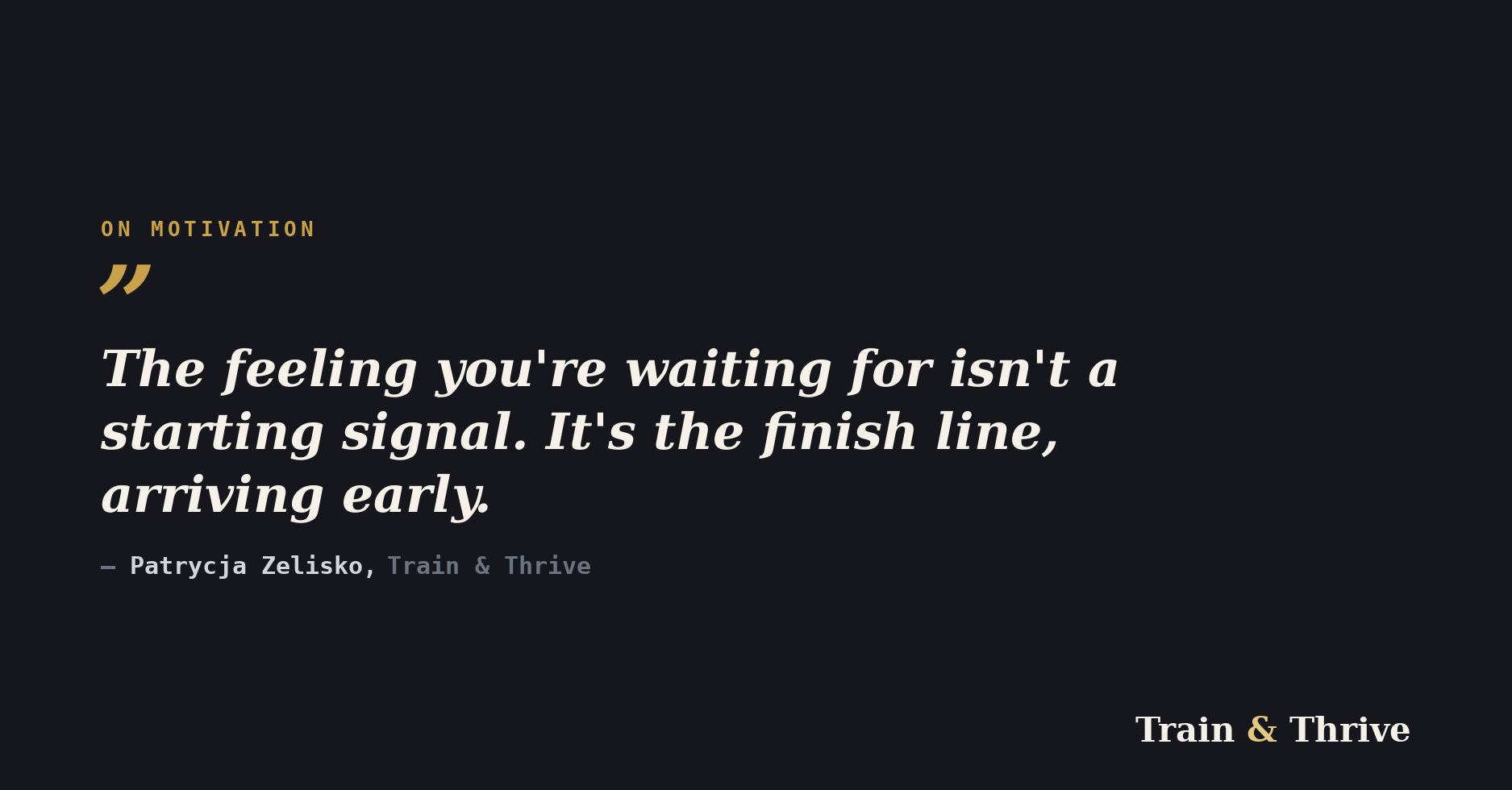
The Insight: The Feeling You're Waiting For Isn't a Starting Signal
It's usually the finish line, arriving early.
Neuroscience backs this up in more places than the original rat study.
Berridge's work (2016) shows wanting and liking run on separate circuits in the brain. You can want something and not enjoy it (most of addiction, in one sentence), or enjoy something completely and feel no drive to go get it. They were never wired together. That's why "I'll start when I feel like it" doesn't hold up: it assumes an order that doesn't exist.
Wolfram Schultz's classic monkey studies (1997) found something that explains why this gets easier the more you do it. Early on, a monkey's dopamine neurons fired only when a reward (juice) actually arrived. But once the monkey learned that a cue reliably predicted the juice, the dopamine fired at the cue instead, before the juice ever arrived. The reward chemical moved earlier. Show up consistently enough, and your brain starts releasing the "go get it" signal at the cue: putting your shoes on, opening the app, walking into the room, rather than waiting for the workout itself. Consistency isn't just habit. It's retraining where your own brain puts the reward.
Then there's the part that answers "will I actually feel better afterwards," because that's the part people doubt most in the moment. Fuss and colleagues (2015) found that exercise triggers measurable anxiety reduction through the body's endocannabinoid system: block that pathway in mice, and the calming effect disappears, even though the exercise still happened. Separately, a meta-analysis by Reed and Ones (2006), pooling dozens of studies, found a robust, moderate mood boost after a single bout of aerobic exercise. And, tellingly, low-to-moderate intensity produced the biggest gains, not brutal effort. You don't need to smash yourself to get the payoff. You need to show up.
And for the days this isn't about a workout at all (a hard conversation, a piece of work, a decision you've been avoiding), the same logic holds outside the gym entirely. Behavioural activation, one of the most rigorously tested treatments in clinical psychology, asks people to schedule and do meaningful activity on a fixed structure, whether they feel ready or not. In a major trial, Dimidjian and colleagues (2006) found this approach performed as well as antidepressant medication for severely depressed patients, and outperformed talk therapy alone. Structured action, on its own, changed how people felt. Not the reverse.
There's a specific brain region behind why "push through anyway" works, and it's one Andrew Huberman talks about often on his podcast: the anterior mid-cingulate cortex. Neuroscientist Josef Parvizi and colleagues at Stanford (2013) electrically stimulated this exact region in patients undergoing brain surgery, and something unexpected happened: instead of triggering movement, it triggered will. One patient described a rising urge to push through a challenge that wasn't even there, saying she needed to "push harder, push harder, push harder to try and get through this." Huberman calls it the brain's tenacity hub, and points to research showing it's more active in people who successfully resist temptation and smaller in people who are depressed or hopeless, while a separate Northwestern study (Sun et al., 2016) found this same region stays statistically indistinguishable from a young adult's in "SuperAgers," the small group of 80-year-olds with the memory of someone decades younger.
The part that matters for you: this circuit isn't fixed. Every time you do the thing you don't feel like doing, you're not just getting through the task; you're strengthening the exact structure that makes the next hard start easier.
Here's what that looks like in practice, broken down:
- Stop treating "not feeling it" as a signal to wait. Berridge's research shows liking was never a precondition for wanting to fire. The feeling isn't missing. It just isn't required.
- Expect the payoff to show up during or after, not before. Schultz's monkeys show us the reward chemical moves to whatever comes right before the good part. For you, that's the act of starting. The more consistently you start, the earlier that signal arrives, until "not feeling it" barely registers at all.
- Trust the body to deliver, even at low effort. Reed and Ones' data says you don't need a brutal session to get the mood lift: a light run, a short class, is enough to move the needle. Fuss's research shows the calming effect is a real, measurable biological event, not a story you tell yourself after.
One honest limit from me right now: this is for the ordinary resistance before something that's good for you: a session, a run, a hard but necessary conversation. It is not a reason to push through real burnout, injury, or exhaustion your body is trying to warn you about. Knowing the difference between "I don't feel like it" and "I actually need rest" is its own skill, and it deserves more care than a single article can give it.
What To Do With This Today
You don't need to talk yourself into feeling ready. You need one honest check and one small action.
The check: Notice, next time you don't feel like starting, that the feeling you're waiting for has never once arrived before you moved. Not once. It always shows up during or after.
The action: Do the smallest possible version of the thing anyway. Shoes on. First minute of the run. First line of the message. Let your brain catch up to what your body already started.
The question I'll leave you with
We treat "I don't feel like it" as a verdict, when it's really just a starting condition — one that has almost nothing to do with how the next hour is going to go.
So next time you're standing at the door in your kit, staring at a message you've been avoiding, or lacing up for something you already suspect you'll be glad you did: ask yourself what you're actually waiting for. Because the evidence says it isn't coming first. It's coming for you, on the other side of starting.
I'd love to hear where you notice this most: training, work, a conversation you've been putting off, or somewhere else entirely.
If you want help building this as a repeatable practice rather than something you have to rediscover every time, that's most of what coaching with me actually is.
References
- Berridge, K. C., & Robinson, T. E. (2016). Liking, wanting, and the incentive-sensitisation theory of addiction. American Psychologist, 71(8), 670–679.
- Dimidjian, S., Hollon, S. D., Dobson, K. S., et al. (2006). Randomised trial of behavioural activation, cognitive therapy, and antidepressant medication in the acute treatment of adults with major depression. Journal of Consulting and Clinical Psychology, 74(4), 658–670.
- Fuss, J., Steinle, J., Bindila, L., et al. (2015). A runner's high depends on cannabinoid receptors in mice. Proceedings of the National Academy of Sciences, 112(23), 7895–7900.
- Reed, J., & Ones, D. S. (2006). The effect of acute aerobic exercise on positive activated affect: A meta-analysis. Psychology of Sport and Exercise, 7(5), 477–514.
- Schultz, W., Dayan, P., & Montague, P. R. (1997). A neural substrate of prediction and reward. Science, 275(5306), 1593–1599.
Originally published on LinkedIn.